
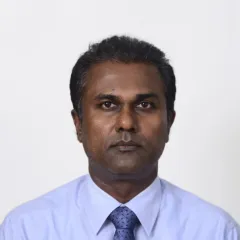
Sanka Perera
About Sanka's Work
Dr. Sanka Perera is a Senior Lecturer in the Department of Earth Observation/Remote Sensing and GIS at the Faculty of Geomatics, where he leads research and teaching in photogrammetry, Earth Observation/Remote Sensing, and geospatial analytics. He holds a PhD in Photogrammetry and Earth Observation/Remote Sensing, with a research focus on 3D building reconstruction from airborne LiDAR and aerial imagery. His MSc research focused on developing novel filtering algorithms for airborne laser scanning (ALS) point clouds.
Dr. Perera’s research integrates LiDAR data—including terrestrial and spaceborne systems such as GEDI—UAV imagery, and advanced AI techniques to estimate forest structure, biomass, and other environmental parameters. His work spans land use/land cover (LULC) change detection, deep learning for Earth Observation/Remote Sensing, and algorithm development for 3D spatial modeling. He is particularly interested in the use of Graph Neural Networks (GNNs), Mask R-CNN, and artificial neural networks (ANNs) to extract complex features from Earth observation data.
He currently serves as the national LiDAR consultant for the Climate Resilience Improvement Project (CRIP), funded by the World Bank, where he contributes to enhancing data quality for disaster risk reduction and environmental planning. He is also involved in several other ongoing environmental monitoring and conservation initiatives, including the GCF- Knuckles Conservation Project.
Dr. Perera’s work aligns closely with the mission of the Global Land Programme, focusing on land system science, ecosystem monitoring, and the application of geospatial technologies to understand and support sustainable land use and climate resilience. As both an educator and researcher, he is committed to advancing geomatics education and applying innovative spatial tools to address pressing global land and environmental challenges.