
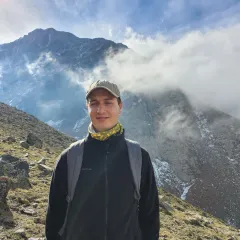
Joaquin Asad
About Joaquin's Work
I was born and raised in Buenos Aires, but my childhood summers were spent at my uncle´s livestock farm, located in northeastern Argentina, a region of the subtropical savannas of the Gran Chaco Biome. During these formative years, my passion and curiosity for nature were ignited through explorations of grasslands and forests alongside my cousin when we were both just 10 years old. As a teenager, I had already decided that my future career would be closely tied to nature conservation.
I chose to pursue Environmental Sciences at the Faculty of Agronomy of the University of Buenos Aires, without fully knowing about the career opportunities this field would offer. In my fourth year, I had the chance to begin working on my bachelor's thesis in the Department of Agricultural Engineering and Land Use. This research increased my passion for conserving grasslands ecosystems, focusing on identifying sustainable alternatives to the environmentally degrading livestock management practices prevalent in the sub-humid temperate grasslands of the Pampa Biome. This research also merged my childhood passion with a newfound interest I discovered during my undergraduate studies: the application of Geographical Information Systems (GIS) to address environmental challenges. This project marked my first experience in academia.
Following my thesis dissertation and my graduation as an environmental scientist in December 2022, I started writing a scientific paper to publish my thesis results. This project received support from members of the NGO Wildlife Foundation of Argentina (Fundación Vida Silvestre), an inspiring group of people with a vocation to conserve native ecosystems. The paper was published in the Journal of Rangeland Ecology and Management (https://doi.org/10.1016/j.rama.2024.06.010). This experience further solidified my commitment to follow an academic career in nature conservation.
My decision to pursue an academic path is primarily motivated by the concerns surrounding unsustainable agricultural and livestock management practices that have prevailed in Latin America for the past century. These issues include abusive land use changes, such as deforestation and deliberate wildfires, contributing to biodiversity loss and soil degradation.
Today, I am in my third year as a Ph.D. student at the Argentine Institute for Dryland Research of the National Scientific and Technical Research Council (IADIZA – CONICET), situated in Mendoza, Argentina. My research focuses on understanding the patterns of riparian biodiversity and its role in facilitating ecosystem services and ecological connectivity across landscapes of the Monte Desert, with varying degrees of anthropogenic impact, including mountain rivers, irrigated agroecosystems, urbanized environments, and wetlands.