
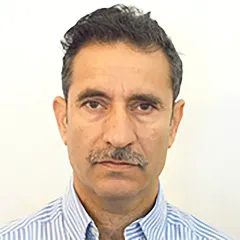
Ahmad Khan
About Ahmad's Work
Ahmad Khan is a Geospatial Scientist and Conservation Biologist. He has a Ph.D. in Geography from the University of Maryland, College Park, where is currently serving as an Assistant Research Professor. Dr. Khan’s research focus is on spatial and temporal dynamics of the land surface using satellite imagery. During his Ph.D, Dr. Khan established a turn-key model for crop area estimation applying remotely sensed Landsat seasonal time-series. Dr. Khan has Masters in Conservation Biology and Sustainable Development from the University of Wisconsin at Madison. As a master thesis, he worked on the post-war assessment of Lake Ab-e-Estada in Afghanistan. This was first ever post-war study of a wetland protected area in Afghanistan. As his first degree, Ahmad Khan did B.Sc. in Forestry from the Pakistan Forest Institute. His professional life of over 30 years as a Conservation Biologist include working with the Government of Khyber Pakhtunkhwa as a Wildlife Officer, with WWF Pakistan as a Senior Conservation Officer and then Director Regional Program & renewable energy technologies, and Program Manager, Regional Program and Fund Raising for the Pakistan Wetlands Program. As a development practitioner, Dr. Khan introduced renewable energy technologies as an alternate to conventional measures for conservation. Identifying the sites and leading the establishment of the Broghil and Qurambar National Parks in KPK and in GB respectively is to his credit. He worked on conservation of cranes, snow leopard, wetlands, chilghoza forests and marine cetaceans, high-altitude peatlands and other subjects.