I think I would classify myself most as a human-environment geographer, which means, for the most part, I get to dabble in a bunch of sub-fields and work with different types of data and methods, literatures, and interdisciplinary collaborators. I think that at the heart of dealing with changing human-environment relations are questions that demand interdisciplinarity and collaboration, and that is what I prioritize in my research. Most of the work I do is in and on Central America (especially Guatemala and Honduras), including some of the research that helped inspire the Realizing the Social Benefits of LSS Data Working Group under GLP. Along with my co-WG leads, Rose Pritchard and Tim Foster from the University of Manchester – as well as a broader team of really stellar international scholars – I am engaged in the Just Earth Observation for Conservation (JEOC) project. While this project examines how earth observation data is used in terrestrial area-based conservation, I also work with other GLP members – such as on migration and remittances, and land rights and tenure – to bridge remote sensing and large quantitative datasets with qualitative data to address questions related to climate justice and social inclusion.
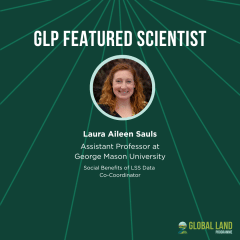
GLP Fall Featured Scientist Laura Sauls
Learn about GLP's Fall Featured Scientist
Laura Aileen Sauls joined the Global Affairs Program in 2022 as an Assistant Professor focusing on the global environment. Before joining the program, she was previously a Leverhulme Early Career Fellow in the Department of Geography at the University of Sheffield (UK) and a Teaching Fellow at the College of the Holy Cross (Worcester, MA USA). Previous to pursuing her PhD, Laura worked for the U.S. Environmental Protection Agency on multilateral environmental policy, including related to climate change, sustainable development, and Arctic environmental cooperation.
Her research draws on political ecology and critical development studies to examine how resource-governing institutions change in the context of global environmental crises and political economic shifts. Incorporating an environmental justice lens and a deep commitment to engaged and collaborative research, Laura works with Indigenous and forest-based community organizations across Mexico and Central America to understand what just and sustainable resource governance might look like across scales. Her most recent projects explore how emerging remote sensing and near-earth observation technologies intersect with ongoing land rights struggles and governance arrangements.